

Security staffing companies operate in an environment that can make managing cash flow challenging. While clients often pay invoices on net 30, net 45, or longer payment terms, employees must be paid weekly or bi-weekly, creating a consistent cash flow gap. This difficult timing can limit long-term business growth, strain operations, and make it harder to take on new contracts for security personnel.
Fortunately, there’s a financing solution built for this cash flow problem called invoice factoring. In this article, we will walk through what this type of financing is, how it works, and why it’s a good fit for security staffing firms. Read on to see how factoring can stabilize your agency’s cash flow.
What Is Invoice Factoring for Security Guard Staffing Agencies?
Invoice factoring, also called payroll funding, is a type of alternative financing that many B2B companies turn to when faced with rapid business growth or difficulty accessing traditional funding. Factoring involves selling unpaid invoices to a factoring company in exchange for an immediate cash advance. This allows invoices with long payment terms, such as net 30 or net 60, to be converted into working capital, which can then be used before the outstanding invoices are paid.
Security staffing companies tend to be a good fit for invoice factoring since payroll is typically paid on a weekly or bi-weekly basis but clients often take at least a month to pay their invoices.
How Does Factoring Work for Security Staffing?
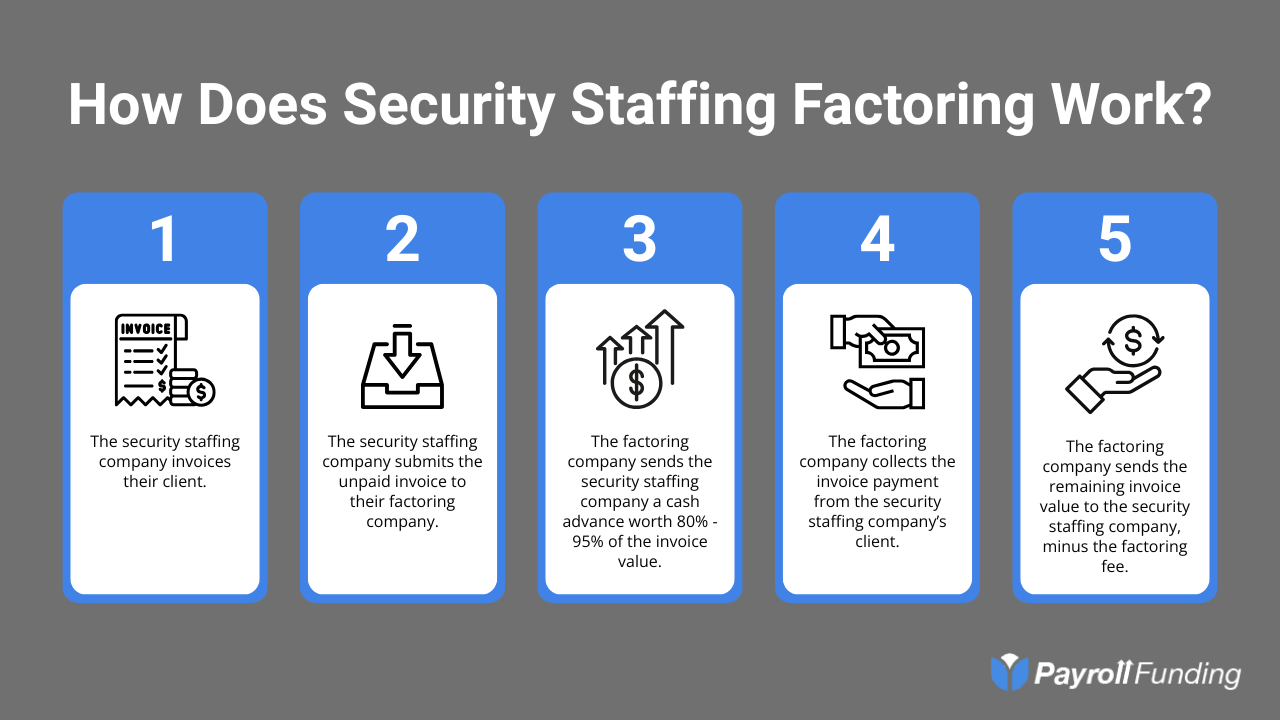
Invoice factoring for security guard companies works the same as it does for other types of staffing firms. The factoring process is as follows:
- Security staffing agency invoices its client.
- Security staffing agency sells the unpaid invoice to the factoring company.
- The factoring company advances 80% to 95% of the invoice value to the security staffing agency.
- The factoring company collects the invoice payment from the debtor on behalf of the security staffing agency.
- The factoring company releases the remaining invoice value to the security staffing agency, minus the factoring fee.
Benefits of Invoice Factoring for Security Staffing Companies
Invoice factoring provides many benefits to security staffing firms, especially those that operate on long invoice payment terms but have weekly or biweekly financial obligations. Factoring allows security staffing companies to sell their unpaid invoices to receive cash upfront, reducing stress caused by slow cash flow and helping business owners operate more confidently. In addition to the cash advance, invoice factoring offers the following benefits for security guard staffing companies:
- Confidence to make payroll on-time
- Stabilized cash flow
- Same-day access to working capital
- Back office and invoice collection support
- Ability to staff new contracts and scale more quickly
- Free debtor credit checks
- Reduced administrative stress
- Smooth operations without disruption
- Collateral-free access to capital
- Debt-free financing
Additionally, because factoring companies put more emphasis on a client’s debtors’ credit histories than on the client’s creditworthiness, it can be easier for startup security staffing agencies and those with less-than-ideal credit to qualify for factoring. This accessibility makes it appealing for those that may not qualify for traditional financing options, such as loans and lines of credit.
Who Is Security Staffing Factoring Ideal For?
There are a few scenarios in which a security staffing firm may be a particularly good fit for factoring, which we’ve outlined below:
- Rapid growth: if your security guard staffing company is growing quickly, your cash flow may be strained. Invoice factoring fills the gap between paying vendors and being paid, making it easier to scale your business.
- Insufficient credit: business owners that have less-than-ideal personal credit scores (for example, below 500) may find it difficult to access financing, but many factoring companies work with these companies when others won’t.
- Less than 12 months old: startups tend to have a tougher time accessing capital because lenders want to see at least a year of operating history before extending credit or offering a loan. However, factoring companies will work with new startups, as long as they have at least one client they are actively invoicing.
- Seasonal fluctuations: if your security staffing company faces seasonal changes in work or event-based spikes in demand, you may find it difficult to pay the increased number of security guard employees without dipping into your reserves. Invoice factoring makes it easier for you to meet payroll demands without financially straining the company.
- Large contracts: many security staffing agencies start small, taking on contracts that they can manage through self-funding. However, once a large opportunity arises, cash flow may become difficult with the increase in expenses and delay in getting paid for the services rendered. The cash advance provided through factoring can make the jump in payroll more manageable and allow you to seize business opportunities as they emerge.
How to Choose a Factoring Company for Your Security Staffing Agency
When selecting an invoice factoring company, there are a few considerations that you’ll want to keep in mind to ensure you find a factoring partner that is reliable. Firstly, we recommend looking at factoring company reviews, including testimonials and those from third-party review sites. There’s a wide array of factoring companies out there, so understanding others’ experiences can help you more confidently select a proven lender.
Secondly, you’ll want to consider what aspects of a factoring partnership are most important to you. For some, the cheapest rates are the top priority, while others may focus on quick and effective customer service. You’ll also want to consider the type of factoring (recourse vs. non-recourse) that you are interested in, contract length, speed of funding, and how you submit invoices to be factored (i.e. through an app, email, online portal, etc.).
Pricing is one of the biggest considerations for those looking into factoring. While it can be tempting to choose the company with the lowest rates, that decision can sometimes come at the expense of other important aspects of the service. For example, cheaper rates may mean that you’ll be routed to a call center each time you call the company, as opposed to being routed to an account manager who knows you business and funding practices.
Finally, it’s common for a factoring contract to include many types of fees, so be sure you understand what each fee is before signing. Don’t hesitate to ask questions during the review process as having a clear understanding of the various costs will help you better assess the true cost of factoring with a company. To help you be more prepared, we’ve outlined some of the most common fees that you may see when reviewing your factoring agreement:
- Factoring rate: this is the base rate that you are charged to factor an invoice. This is usually 1% to 5%.
- Incremental rate: This is an incremental fee that is added to the base factoring rate the longer your invoices remain outstanding. Incremental fees are usually 0.5% – 1%.
- ACH and wire fees: these are charged when the factoring company sends the cash advance to your account. Wire fees are more expensive because they allow for same day funding, while ACH fees are cheaper or free but require next day processing.
- Early termination fee: this is charged only when you cancel your factoring contract before the date listed in the agreement.
- Origination fee/contract initiation fee: this is a one-time fee charged at the start of your contract and is sometimes negotiable.
Alternatives to Invoice Factoring for Security Staffing Agencies
There are a few types of financing options that security staffing companies may turn to when the need for funding arises. To make it easier to compare these options, we’ve created the following chart:
| Type of Financing | Description | Pros | Cons |
|---|---|---|---|
| Invoice factoring/payroll funding | Unpaid invoices are sold at a discount in exchange for a cash advance |
|
|
| MCA/ACH loan | Lump sum is provided upfront and repaid overtime through automatic daily or weekly withdrawals from a bank account |
|
|
| SBA loan | Lump sum is provided upfront by an SBA-approved lender and repaid over time |
|
|
| Bank loan | Lump sum is provided upfront by a bank and repaid over time |
|
|
| Line of credit | Credit is provided and can be drawn upon and repaid on an ongoing basis |
|
|
Ready to Get Started?
If you’re ready to start factoring or just simply want to have a conversation about the process, fill out our form, and we will connect you with a trusted provider.